Introduction
Medical billing and medical coding are both important parts of the healthcare revenue cycle. While the two careers work closely together, they have different responsibilities in the healthcare industry.
Medical coders translate medical diagnoses, procedures, and treatments into standardized medical codes. Medical billers use those codes to prepare and submit insurance claims for payment.
Together, medical billers and coders help healthcare providers receive reimbursement for medical services while ensuring patient records and insurance claims are accurate.
In this beginner’s guide, we’ll explain the differences between medical billing and medical coding, how they work together, and why both roles are important in healthcare.
What Is Medical Coding?
Medical coding is the process of converting healthcare services, diagnoses, procedures, and treatments into standardized medical codes.
Medical coders review physician notes, patient charts, lab results, and medical documentation to assign the correct codes for billing and recordkeeping purposes.
Some common code sets include:
- ICD-10 Codes – Diagnosis codes
- CPT Codes – Procedure and service codes
- HCPCS Codes – Medical equipment and supply codes
Accurate coding is important because insurance companies use these codes to process claims and determine reimbursement.
What Is Medical Billing?
Medical billing is the process of preparing, submitting, and following up on insurance claims for healthcare services provided to patients.
Medical billers use the codes assigned by medical coders to create insurance claims and send them to insurance companies for payment.
Medical billers are also responsible for:
- Verifying insurance coverage
- Reviewing patient balances
- Correcting denied claims
- Posting payments
- Communicating with insurance companies and patients
The goal of medical billing is to ensure healthcare providers receive payment accurately and on time.
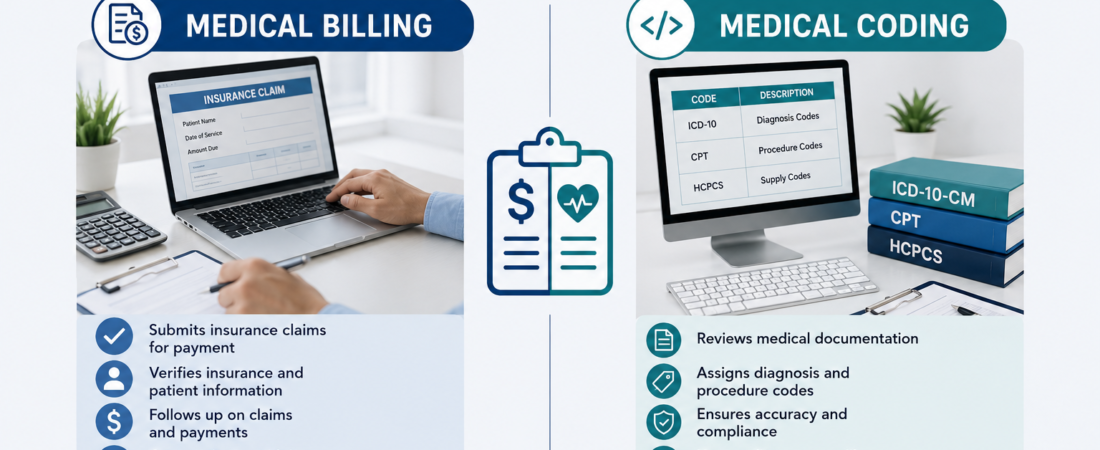
Key Differences Between Medical Billing and Medical Coding
Although medical billing and coding work together, their responsibilities are different.
Medical Coding
- Reviews medical documentation
- Assigns diagnosis and procedure codes
- Ensures coding accuracy and compliance
- Focuses on translating healthcare services into codes
Medical Billing
- Uses assigned codes to create claims
- Submits claims to insurance companies
- Follows up on unpaid or denied claims
- Focuses on payment and reimbursement
How Medical Billers and Coders Work Together
Medical billers and coders work closely together throughout the healthcare revenue cycle.
First, the medical coder reviews the patient documentation and assigns the correct codes. Then, the medical biller uses those codes to submit insurance claims for reimbursement.
If a claim is denied, the biller and coder may work together to identify coding errors or missing documentation that caused the denial.
Both roles are important to ensure healthcare claims are processed correctly and payments are received efficiently.
Skills Needed for Medical Billing and Coding
Successful medical billers and coders often have strong:
- Attention to detail
- Communication skills
- Knowledge of medical terminology
- Understanding of insurance guidelines
- Organization and problem-solving skills
Both careers also require staying updated on healthcare regulations and coding changes.
Career Opportunities
Medical billing and coding professionals can work in:
- Hospitals
- Physician offices
- Insurance companies
- Outpatient clinics
- Healthcare consulting companies
- Remote healthcare positions
As healthcare continues to grow, demand for skilled billing and coding professionals remains strong.
Why These Roles Are Important
Medical billing and coding help healthcare organizations:
- Receive proper reimbursement
- Maintain accurate patient records
- Reduce claim denials
- Improve compliance
- Support efficient healthcare operations
Without accurate billing and coding, healthcare providers could face payment delays, denied claims, and compliance risks.
Conclusion
Medical billing and medical coding are different but closely connected roles within the healthcare industry.
Medical coders translate healthcare services into standardized codes, while medical billers use those codes to submit insurance claims and manage reimbursement.
Together, both roles play a critical part in keeping the healthcare revenue cycle running smoothly and ensuring healthcare providers are paid accurately for the services they provide.