
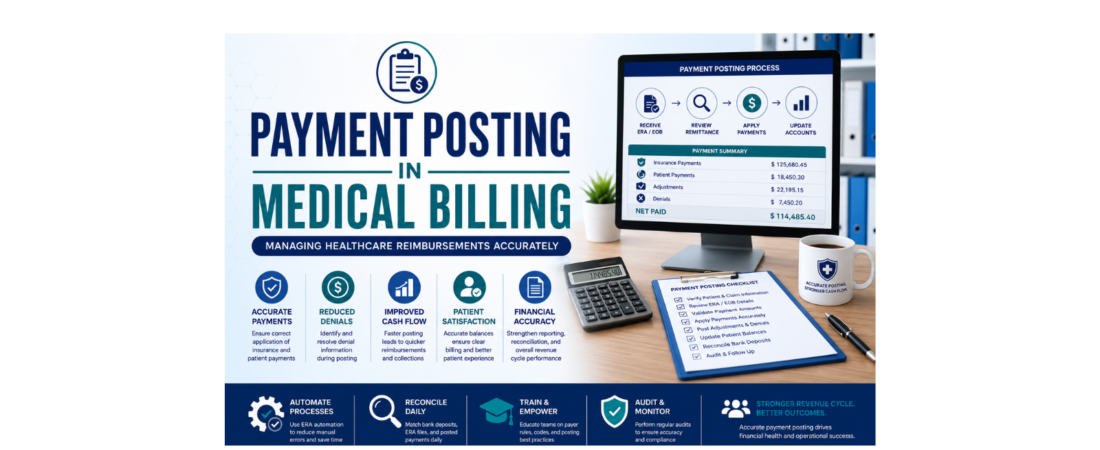
What Is Payment Posting in Medical Billing?
Payment posting is one of the most important financial functions within the healthcare Revenue Cycle Management process. It involves accurately recording insurance payments, patient payments, contractual adjustments, denials, and reimbursement activity into the healthcare billing system after claims have been processed by insurance companies.
Once insurance companies adjudicate healthcare claims, they issue payments along with Explanation of Benefits (EOBs) or Electronic Remittance Advice (ERA) reports that explain how the claim was processed. Payment posting teams review this information and apply payments, adjustments, coinsurance balances, deductibles, copayments, denial codes, and patient responsibility amounts to patient accounts.
Accurate payment posting directly impacts financial reporting, Accounts Receivable management, denial follow-up, patient billing accuracy, reimbursement reconciliation, and overall healthcare financial performance. Errors during payment posting may create incorrect account balances, inaccurate patient statements, unresolved denials, underpayment issues, or compliance concerns.
Healthcare organizations often process both electronic and manual payments from commercial insurance companies, Medicare, Medicaid, managed care organizations, workers compensation carriers, and patient payments. Payment posting teams must carefully review payer remittance information to ensure payments are applied correctly according to payer contracts and reimbursement guidelines.
Because payment posting affects multiple downstream Revenue Cycle functions, healthcare organizations frequently utilize automated ERA posting systems, reconciliation processes, payment audits, and denial tracking workflows to improve financial accuracy and operational efficiency.
Why Payment Posting Is Important
Payment posting plays a major role in maintaining accurate financial records and supporting healthcare reimbursement performance. Correct payment application helps healthcare organizations properly track insurance reimbursements, patient balances, contractual adjustments, denial activity, and Accounts Receivable performance.
Accurate payment posting also supports denial identification and reimbursement recovery efforts. Many denial trends, underpayments, coding issues, authorization problems, and payer processing errors are first identified during payment posting review when remittance details are analyzed carefully.
Healthcare organizations rely on payment posting to maintain accurate patient account balances and financial transparency. Incorrect payment application may result in inaccurate patient billing statements, duplicate balances, overpayments, refund issues, or delayed collection activity.
Payment posting additionally impacts Revenue Cycle reporting metrics such as net collection rates, reimbursement performance, denial rates, payment variance analysis, and aging account balances. Financial leaders often utilize payment posting data to evaluate organizational reimbursement trends and operational efficiency.
Organizations that maintain strong payment posting processes generally experience improved financial accuracy, stronger cash flow management, reduced billing errors, and better overall Revenue Cycle performance.
Common Payment Posting Challenges
Healthcare organizations may encounter several payment posting challenges related to payer reimbursement complexity, denial activity, remittance inconsistencies, and manual processing requirements. These challenges may negatively impact financial accuracy and reimbursement follow-up efforts if not managed effectively.
One common challenge involves payer remittance discrepancies where insurance payments do not match expected contracted reimbursement amounts. Underpayments, incorrect adjustments, bundled services, or unexpected denial codes may require additional review and follow-up before accounts can be resolved accurately.
Manual payment posting processes may also increase the risk of data entry errors, incorrect account application, duplicate postings, or missed denial identification. High payment volumes and complex remittance structures may further contribute to operational inefficiencies and reconciliation concerns.
Electronic remittance processing can also create challenges when payer ERA files contain formatting inconsistencies, missing claim details, or incorrect payment mapping within billing systems. Healthcare organizations often require ongoing reconciliation efforts to ensure payment accuracy between bank deposits, remittance files, and patient accounts.
Because payment posting directly affects multiple Revenue Cycle functions, healthcare organizations frequently implement quality review processes, payment audits, ERA automation tools, and denial tracking systems to strengthen operational accuracy and reimbursement oversight.
Improving Payment Posting Accuracy
Healthcare organizations continue implementing workflow improvement strategies designed to strengthen payment posting accuracy and improve reimbursement performance. Effective payment posting processes require strong attention to detail, payer knowledge, reconciliation procedures, and Revenue Cycle coordination.
One important strategy involves utilizing automated ERA posting systems that electronically import payer remittance data directly into the billing system. Automation helps reduce manual posting errors, improve efficiency, and accelerate reimbursement processing timelines.
Many healthcare organizations also maintain daily reconciliation processes to compare bank deposits, electronic payments, remittance reports, and posted account activity to ensure financial accuracy and identify discrepancies quickly.
Ongoing staff education remains equally important because payer reimbursement methodologies, denial codes, contractual adjustments, and remittance formats frequently change. Payment posting teams often receive training related to payer policies, ERA interpretation, reimbursement analysis, denial identification, and reconciliation procedures.
Organizations that prioritize payment posting quality improvement often experience stronger financial reporting accuracy, improved cash flow visibility, lower reconciliation errors, and better overall Revenue Cycle performance across healthcare operations.
Final Thoughts
Payment posting remains one of the most important financial functions within healthcare Revenue Cycle Management. Accurate payment application supports reimbursement integrity, financial reporting accuracy, denial management, patient billing transparency, and overall operational efficiency across healthcare organizations.
As healthcare reimbursement systems continue evolving, organizations that prioritize payment posting accuracy, reconciliation oversight, automation technology, and staff education are often better positioned to improve financial performance and reduce reimbursement discrepancies.
Understanding payment posting is important for healthcare professionals, medical billers, payment posting specialists, Accounts Receivable teams, administrators, and Revenue Cycle leaders involved in healthcare reimbursement operations. Strong payment posting workflows not only improve financial outcomes but also contribute to more accurate and efficient healthcare billing processes throughout the healthcare industry.